A public adjuster's work on a Chicago property claim runs in five stages: reading the policy, documenting the damage, building an independent line-item estimate, negotiating the difference with your carrier, and chasing the second check once repairs are done. The concentrated work is measured in hours. The calendar is measured in weeks, because most of the waiting sits on the carrier's side of the table, not mine.
People usually ask me what a public adjuster costs before they ask what one actually does. I understand why, but it is the wrong order. The fee is a percentage of a number that does not exist yet; the work is what decides that number. So here is the honest version — the sequence I follow on a Chicago claim, what happens in each stage, roughly how long each one takes, and which parts of it are waiting rather than working.
I am writing this about Illinois and Indiana, the two states I am licensed in. Nothing here is legal advice, and no adjuster who is being straight with you will promise an outcome. What follows is process, not prediction.
What happens in the first hour after you call?
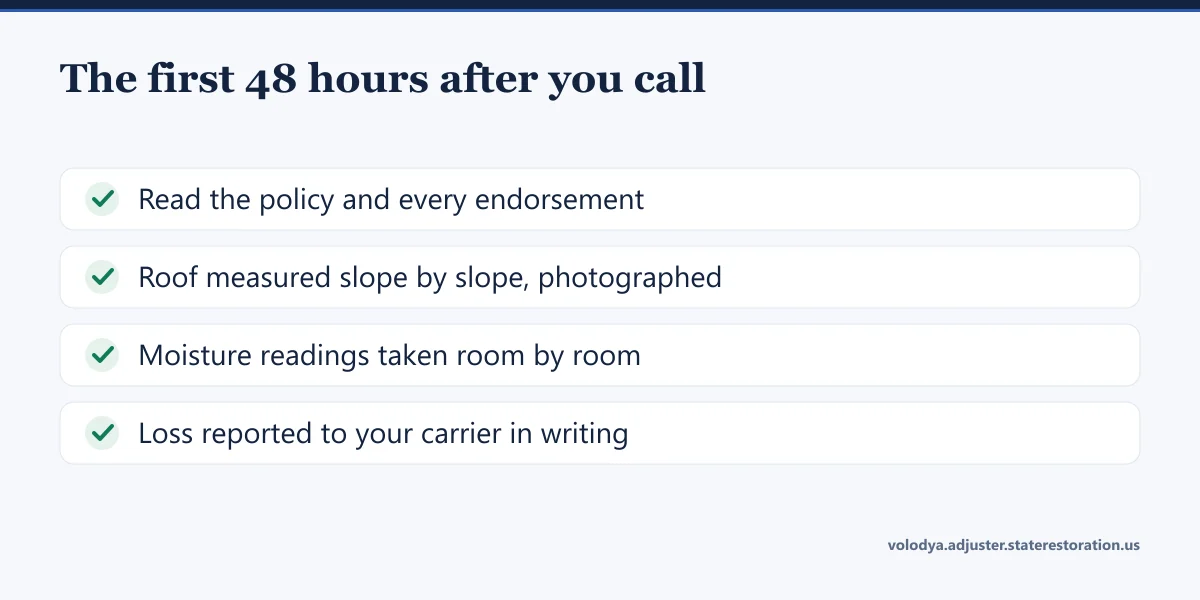
I ask what happened, when it happened, and whether the property is safe right now. Then I ask for the policy — the whole declarations page and every endorsement, not the summary. That first conversation is usually twenty minutes. Reading the policy properly afterwards takes longer than the call did.
The reason the policy comes before the damage is that the damage does not tell you what is owed. Two identical roofs on the same Chicago block can settle completely differently depending on whether one carries replacement cost and the other actual cash value, whether there is a percentage wind-and-hail deductible, whether ordinance-and-law coverage exists for code upgrades the city will require, and whether a cosmetic-damage exclusion has been quietly added at renewal. None of that is visible from the ground. All of it is visible on page four.
If the loss has not been reported yet, we report it in writing and I go on the file as your representative, so the carrier's correspondence comes to both of us. If you have already given a recorded statement, that is fine — it simply means I read it before anything else.
What does the inspection actually involve?
A full documented inspection of a single-family Chicago home usually takes me two to four hours on site. Roof slope by slope, elevations, interior room by room, with photographs, measurements and moisture readings as I go. It is longer than most homeowners expect, and considerably longer than a queue inspection.
On a storm claim the roof is where the argument will happen, so it gets the most time. I am HAAG certified (inspector #992104047) and I hold an Illinois roofing contractor licence (#105.009193), which matters here for one practical reason: hail and wind damage on asphalt shingles has to be identified by an agreed standard, marked in test squares, and photographed in a way another professional can check. Damage that is described but not documented does not survive a disagreement. Damage that is documented to the standard the carrier's own experts are trained on is much harder to wave away.
Interiors get the same treatment. Moisture meter readings recorded room by room, ceilings and wall cavities checked where water travelled rather than only where it showed, and contents photographed before anything is cleaned up or thrown away. If you have already thrown things out, tell me — we work from what we have and say so plainly, rather than pretending the file is complete.
How long does the estimate take to build?
Typically a few days after the inspection, not the same evening. The estimate is a measured, line-item scope priced at current local construction cost — the same kind of document the carrier produces, written in the same estimating language, so the two can be compared line against line instead of number against number.
That comparison is the entire point. A single settlement figure cannot be argued with; a scope can. Below is the sequence and where the time actually goes on a straightforward residential storm claim.
| Stage | My working time | Typical elapsed time | What you do |
|---|---|---|---|
| Intake and policy review | 1–3 hours | Day 1–2 | Send the full policy and any correspondence |
| On-site inspection and documentation | 2–4 hours | Within the first week | Give access; point out what you noticed |
| Line-item estimate prepared | 3–6 hours | A few days after inspection | Nothing |
| Claim submitted, carrier re-inspection | 2–3 hours on site | Set by the carrier's calendar | Nothing |
| Negotiation and supplements | Varies widely | Weeks, sometimes longer | Approve decisions; they stay yours |
| Repairs, then recoverable depreciation | 1–2 hours of paperwork | After the work is completed | Keep every invoice |
Read that table honestly and you will notice something: the columns disagree. The working hours across an ordinary claim add up to a couple of days. The calendar runs for weeks. Almost all of the gap is waiting on the carrier — for an inspection slot, for a desk review, for a supplement decision. That is normal, it is not a sign anything has gone wrong, and it is the single most common reason people call me frustrated in week five.
What happens when my number and the carrier's number disagree?
We argue the scope, item by item, in writing. Disagreements are rarely about the whole claim — they are usually about a handful of specific lines that were left out or priced short, and each one is settled on its own merits with photographs, measurements and code references attached.
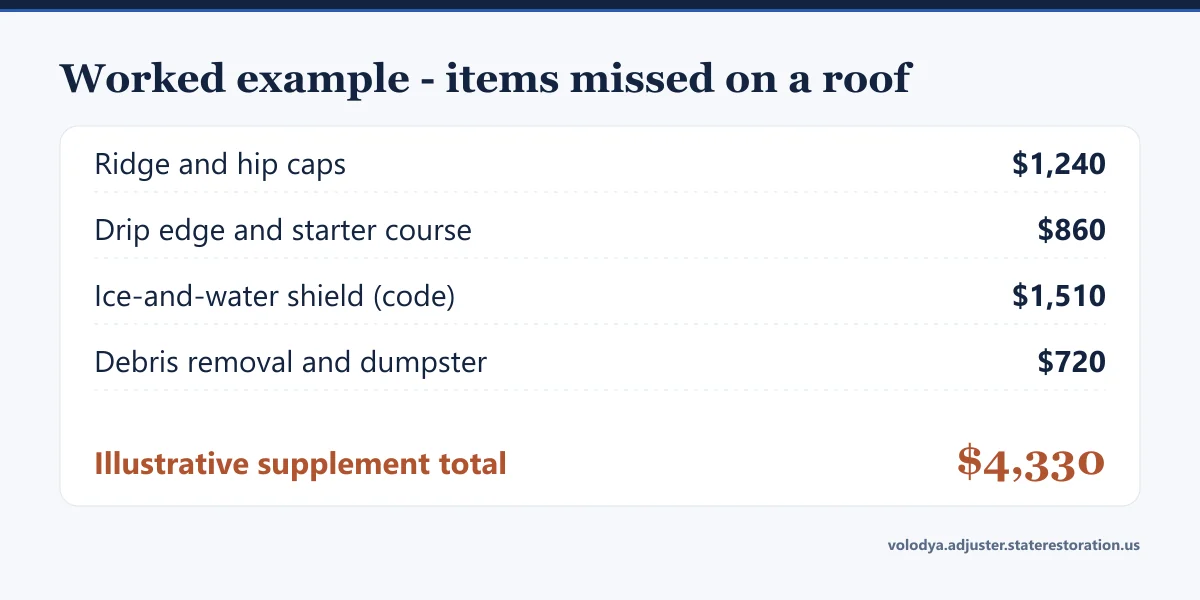
The items that go missing are predictable enough that I check for them every time. Below is an illustrative worked example only — invented figures, used to show the shape of a supplement on a roof claim, not a typical result and not a promise of anything. Your policy, your damage and your carrier decide your numbers.
| Line item | Why it gets left out | Illustrative amount |
|---|---|---|
| Ridge and hip caps | Counted as field shingles rather than a separate item | $1,240 |
| Drip edge and starter course | Not visible in photographs taken from the ground | $860 |
| Ice-and-water shield | Required by code on the rebuild, not present on the original roof | $1,510 |
| Debris removal and dumpster | Treated as included in the roofer's overhead | $720 |
| Illustrative supplement total | — | $4,330 |
Notice that not one of those lines is a dispute about whether the roof was damaged. They are scope omissions — things a repair genuinely requires that a first estimate did not list. That is why a supplement is normal rather than adversarial, and why the first estimate on a claim is so rarely the last one.
Where a disagreement stops being about scope and becomes a question of coverage — a denial you believe misreads the policy, or a dispute over what a clause means — I will say so directly, and I will tell you when a lawyer is the right person to talk to. I am a licensed public adjuster, not an attorney, and the line between the two jobs is one I do not blur.
What do you have to do while this runs?
Less than you would think, but four things matter and only you can do them. None takes long, and all of them are worth more at the start of a claim than at the end of it.
- Photograph everything before anything is cleaned up. Wide shots of each room and elevation, then close-ups. Undocumented damage effectively did not happen, and the mitigation you are required to do will remove the evidence.
- Keep every receipt and invoice. Tarps, board-up, a plumber at midnight, a hotel night. Emergency mitigation is often payable, and it is paid against paperwork.
- Get anything important in writing. If a denial, a partial denial or a coverage position is explained to you on the phone, ask for it by email. A written position can be answered; a remembered phone call cannot.
- Do not sign a contractor's paperwork that assigns your claim. Read what you are signing after a storm. In Illinois, negotiating a claim on your behalf is work reserved for licensed public adjusters and attorneys — a roofer offering to "handle the insurance" is either stepping over that line or planning to build whatever the carrier happens to approve.
How long does a whole claim take, honestly?
A clean, undisputed residential claim can be finished in a few weeks. A disputed one runs for months. I cannot give you a date, and anyone who gives you one at the first meeting is guessing at your carrier's timetable.
What I can do is tell you which stage we are in and what we are waiting for, which is usually the thing people actually want. Silence is what makes a claim feel like it has stalled, and most of the time the claim has not stalled at all — it is sitting in a queue. My hours are Monday to Friday 9–6, Saturday 9–5 and Sunday 10–5, and I would rather you called with a question in week three than sat on it until week eight.
When is none of this worth it?
Frequently, and I will tell you so on the first call rather than after you have signed something. If the damage is clearly below or barely above your deductible, there may be no recovery to share and filing at all may be the wrong move. If it is one obvious item — a single window, a fence panel — the scope is not in dispute and there is nothing to argue. If the carrier's estimate already matches real local repair quotes, the claim is being paid correctly, and you should take it.
Representation earns its place when a claim has scope worth arguing about: multiple trades, hidden or disputed damage, matching questions, code upgrades, a denial you think is wrong, or a settlement that will not cover the quotes in front of you. That is the honest test, and it is the same test I apply before taking a file.
What to do next
If the damage has already happened: make the property safe, stop it getting worse, photograph everything before anything is cleaned up, and keep the receipts. Then get a straight read on what your policy owes you before you accept a figure.
That read is what the free inspection and policy review is — I look at the damage and the policy and tell you where you stand, including when the answer is that you do not need me. The offerings page sets out the four kinds of work in detail, from residential claims through to renegotiating a claim that was already underpaid or denied, and my licences and background are published in full so you can verify them before you call. If a first offer has already arrived and it does not look right, a second opinion on the estimate costs you nothing to ask for.
One last thing, repeated because it matters: nothing on this page is legal advice, and no honest adjuster can promise you an outcome. Claims turn on your policy, your damage and your carrier. What representation changes is whether anyone is arguing your side of it.